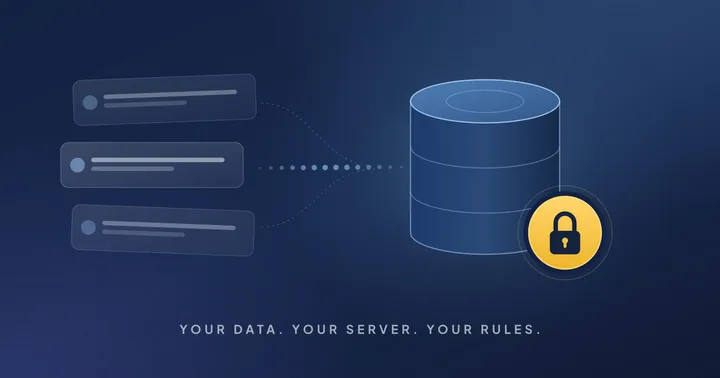
Your Customer Data Should Belong to You: The Case for Open-Source CRM
Your customer list is probably the most valuable thing your business owns. Not the website, not the branding, not the office. The list: who your customers are, what they bought, what they said on the phone last March, which deals are still warm and why.
For most teams, that asset lives on a server they have never seen, in a database they cannot open, under terms that can change with 30 days’ notice. The CRM you choose determines whether that asset stays yours, or quietly becomes dependent on a company you do not control.
It is worth asking how that became normal, and what it would take to fix.
What “You Own Your Data” Usually Means
Nearly every CRM vendor says you own your data. Read the actual agreement and the sentence typically means one specific thing: the vendor does not claim copyright over the records you typed in. That is a fair statement, and it is not nothing. But it is not ownership in any way that helps you on a bad day.
What you really have is access - granted for as long as your subscription is current, through the interfaces the vendor chooses to offer, in the formats they choose to support, at the speed they choose to allow.
To be fair to them: the large hosted CRMs are genuinely good software, run by competent people with security teams most small businesses could never afford. This is not an argument that they are badly built or badly intentioned. It is an argument about where the control sits, which is a different question and one that only becomes urgent at exactly the moment you can no longer do anything about it.
Ownership is what is left over when the relationship ends badly.
Four Questions That Test It
You can find out where you actually stand by answering four questions about your current CRM.
1. Can you read the raw data right now, without asking anyone?
Not “can I click Export”. Can you open a connection, look at the tables, and run a query nobody built a screen for? If the only way to see your own records is through a UI somebody else designed, you are a guest in your own dataset.
2. Can you leave with everything, structure included?
Contacts are the easy part. What about notes, tags, deal values and stages, the links between a person and their organization, and the timestamps that tell you when any of it happened? A flat CSV of names and email addresses is the shape of the export feature, not the shape of your business.
3. Can you keep working exactly as you are if the vendor changes course?
Prices rise. Features move up a tier. Companies get acquired, pivot, or shut a product down with a six-month window. If that happens, does your data stay usable on day one of the following month? For a hosted product, the answer depends on decisions made by people you will never meet. That is not an accusation, it is just where the control sits.
4. Can you say, precisely, who else has seen it?
Not “we trust them”. Can you name the subprocessors, the analytics pipeline, the support tooling with production access, and the terms covering whether your records train anything? If answering means opening a policy page that was last revised without telling you, the honest answer is no.
If any of those made you think “I would have to check the contract”, that is the finding. Your control over your customer data currently depends on another company’s policies, pricing, and technical decisions. That may well be a trade you are happy to make, and for plenty of businesses it is the right one. The problem is when it gets made by default rather than deliberately.
Custody Has a Price, and You Pay It Quietly
None of this requires a villain. It is just what the incentives produce when someone else holds the database.
- Pricing power follows the data. Vendor lock-in is rarely a policy anyone wrote down. It is just the accumulated cost of leaving, and the harder it is to leave, the less a price increase needs to be justified. That is not cynicism, it is how renewal conversations work.
- Per-seat billing taxes your growth. Adding a contractor for three months becomes a budget decision instead of an admin task.
- Access to your own records gets tiered. Reporting, the API, and bulk export have a way of living one tier above whichever one you are on.
- Opaque structure limits what you can ask. Any question the reporting screen was not built to answer becomes a support ticket or a “roadmap consideration”.
- Your compliance story inherits their chain. Under GDPR you are the controller. Every subprocessor your vendor adds is a paragraph you now have to understand and defend.
- Deletion is a request, not an action. You click delete, and what happens next across replicas, backups, and analytics warehouses is a policy statement rather than something you can verify.
When This Stops Being Theoretical
Architecture arguments are easy to nod along to and easy to forget. These are the moments when the question actually lands on someone’s desk.
A salesperson leaves. They ran twenty accounts for three years. Can you sit down the following Monday and pull every note, every commitment, and every open deal they were carrying, in a form the person replacing them can actually use? If the answer involves asking IT to file a support ticket with a vendor, the handover has already gone badly.
Year five, the export you need moves up a tier. You have half a decade of relationship history in the system. The full-fidelity export, or the API call volume you would need to pull it, is now an enterprise-plan feature. The data is still “yours” in the contractual sense. Retrieving it has simply become a purchase.
A customer asks what you hold about them. Under GDPR they are entitled to know, and you have a month to answer. That means finding every note, tag, deal, and email address associated with one person, across the whole system. This is straightforward if you can query the database and awkward if you are clicking through search screens hoping you did not miss a record.
The product gets acquired. The new owner has a different strategy, a different price list, or no interest in the segment you are in. The sunset notice gives you six months to move a decade of accumulated relationships into something else, using whatever export tooling exists on the day the announcement lands.
None of these are exotic. Any business that runs for long enough hits at least two of them, and in every case the outcome is decided by a choice made years earlier about where the data would live.
The Database Is the Asset, Not the App
Here is the thing that gets lost in CRM comparisons: the screens are replaceable and the data is not.
Any competent CRM can show you a contact card. What you cannot rebuild is the accumulated substance underneath it - years of who talked to whom, what was promised, which deals stalled and at what value. A CRM database is a small, dense, structured record of every commercial relationship your business has:
- Contacts and organizations, and crucially the links between them.
- Deals with their value, currency, probability, stage, and expected close date.
- Notes attached to the right person, which is where the actual institutional memory lives.
- Tags that encode how you segment your market.
- Users and roles, recording who did what.
- Timestamps on all of it, which is what turns a list into a history.
Losing the app costs you a week of retraining. Losing the structure costs you the memory of the business. That is why the question “where does this data live and who can open it” matters far more than any feature comparison, and why it should be settled before you start typing records into anything.
Where It Physically Sits, and Who Holds the Keys
Data ownership is not an abstraction. It comes down to a handful of very concrete facts about a specific machine.
Location. Which country is the server in? For a European business handling European customer data, “somewhere in our provider’s global infrastructure” is a materially different answer from “a machine in Frankfurt that we chose”.
Credentials. Who can connect to the database? With a hosted CRM, the honest list includes an unknown number of support and infrastructure staff, governed by internal policy you cannot audit. With your own server, the list is the people you gave the password to.
Copies. Every backup is another copy of your customer data, somewhere. If you did not create it, you do not know how many exist, how long they are retained, or what happens to them when you cancel.
Deletion. When a customer exercises their right to be forgotten, you want to be able to say what actually happened, not what was requested. On a database you control, a deletion is a deletion, and your backup rotation is a schedule you set rather than a footnote in someone’s retention policy.
Continuity. Data outlives software. Records you captured in 2019 should still be readable in 2035. That only holds if the data sits in a standard, widely supported format that does not depend on any one company still being in business.
Answer those five and you know exactly how much of your customer data is genuinely yours.
One caveat worth stating plainly, because it gets oversold elsewhere: self-hosting does not make you GDPR compliant. Access control, encryption, retention schedules, deletion processes, server hardening, and breach handling are your obligations either way. What changes is where you implement them. Instead of describing controls you inherited from a vendor and cannot inspect, you are configuring controls on a machine you can reach. That is a better position to defend, but it is a position you still have to earn.
Where Open Source Comes In
Open source matters here for one specific reason, and it is not the one people usually reach for. It is not that you will read the source, and it is not that you will fork anything. Most teams never will, and that is completely fine.
It matters because it changes the nature of the guarantee. A hosted vendor’s commitment to your data is a promise, which depends on their goodwill, solvency, and ownership structure staying as they are today. A license like GPL-3.0 is a property of the software, and nobody can revoke it later.
In practical terms, that property is what keeps your database usable:
- The software that reads your data cannot be taken away from you, so your records never become a folder of exports nobody can open.
- Because the source is public, what happens to a customer record is verifiable rather than asserted. Your privacy policy can describe behaviour someone checked.
- If the project’s direction ever stops suiting you, the community can carry it forward, and your data keeps its reader either way.
That is the whole argument. Open source is not the point; it is the mechanism that stops your data from depending on one company’s continued existence.
Self-Hosting Is Where Ownership Actually Happens
The license alone is not sufficient. Plenty of open source products are sold as a hosted service, and if the vendor still runs the database, you are back to custody with better paperwork attached.
The two things answer different questions:
- Open source answers will there always be software that can read my data?
- Self-hosting answers whose machine is my data on, and who holds the credentials?
You need both. Together, they mean the records were never anywhere but your own infrastructure, and the software that reads them cannot be withdrawn.
The Short Version
If you skipped to here, this is the whole argument in one table. Note that the last row genuinely favours the hosted option, which is the honest trade being made.
| Hosted CRM | Self-hosted open source CRM | |
|---|---|---|
| Database access | Through the vendor’s interfaces | Direct, with any SQL client |
| Full export | Whatever the export feature supports | The database itself |
| Where it physically lives | The provider’s infrastructure | A server and country you pick |
| Who holds credentials | Vendor staff, per internal policy | The people you gave them to |
| Pricing model | Per user, per month | Your infrastructure cost |
| Available in ten years | Depends on the vendor | Source is public, data is standard |
| GDPR controls | Provider’s chain, plus you | Almost entirely you |
| Backups, updates, uptime | Handled for you | Your responsibility |
What That Looks Like in Practice
This is the design premise behind Clientverse, so it is worth being concrete about what it means day to day:
- Your data sits in your own MySQL database, on a server you chose. It uses standard MySQL structures that stay readable with widely available tools, rather than a proprietary format that depends on one vendor’s software still existing.
- You can query it however you like. Contacts, organizations, deals, notes, and tags are all directly reachable, including for the questions no screen was built for.
- Backups are a
mysqldumpyou schedule, so you know how many copies exist, where they are, and how long they live. - The REST API is part of the product, not a tier. Read and write your own records programmatically to feed in web form submissions, sync another system, or build the report nobody shipped.
- Your customer data is not sent to third parties. External connections happen only for integrations you configure yourself. Your subprocessor list stays short, and your privacy notice gets easier to write.
- The software is GPL-3.0 and public on GitHub, which is what guarantees the database above never loses its reader.
- Cost tracks your server, not your headcount. Add users as your hardware allows.
The Trade-Offs, Stated Plainly
Holding your own data means holding the responsibilities that come with it. Backups, updates, TLS certificates, access control, and uptime all move to your side of the line. If the server goes down at 2am, there is no one else on call. Anyone telling you otherwise is selling something.
The honest counterpoint is that the work is smaller than it sounds at this scale. Clientverse runs on an ordinary PHP 8.2+ and MySQL stack behind Apache or Nginx, so a basic VPS or even decent shared hosting is enough to run a self-hosted CRM for a small team.
Budget an afternoon for the install, then one more hour to restore a backup onto a scratch database and confirm the records really came back. That second hour is the one most people skip, and an untested backup is not a backup, it is a hope with a filename.
If you would rather not run a server, managed hosting is available as a premium service. The distinction that matters is that it is the same GPL-3.0 software on the same standard database, so moving onto your own infrastructure later stays a decision rather than a rescue operation.
Start by Testing the Claim
You do not have to take any of this on faith, which is rather the point. Four steps, in increasing order of commitment, and you can stop after any of them:
1. Export your current CRM and open the file. This costs nothing, takes ten minutes, and is the single most clarifying thing you can do. Look at what actually came out. Are the notes there? The tags? The links between a contact and their organization? The dates? Whatever is missing from that file is what you would lose on the day you leave.
2. Try the demo site. Twenty minutes of clicking around tells you whether the workflow fits how you actually sell. No signup, no server, no commitment.
3. Install it on a cheap VPS. An afternoon, on hardware that costs less per month than a single seat of most hosted CRMs. Use the Docker guide if you would rather skip the web server config.
4. Run it alongside your current CRM for a month. Put one team or one pipeline in it. Nothing gets migrated, nothing gets cancelled, and you find out from real use rather than a feature comparison. If it does not fit, you have lost a month of a VPS bill.
Somewhere in step three, do the thing no hosted CRM will ever let you do: open a terminal, connect to the database, and run a SELECT against your own customer records.
That query is what ownership feels like.
If you want to find out whether your customer data can genuinely belong to you, install Clientverse and test it against your own database.
Need Professional Help?
Buy managed hosting, white label licensing, or technical support online - or ask for a quote on custom development and data migration.
Explore Services